Youtube Art Blakey Featuring Lee Morgan and John Gilmore
| Fine art Blakey | |
|---|---|
 | |
| Background information | |
| Birth name | Arthur Blakey |
| Also known as | Abdullah Ibn Buhaina |
| Born | (1919-ten-11)October eleven, 1919 Pittsburgh, Pennsylvania, U.S. |
| Died | October xvi, 1990(1990-10-xvi) (aged 71) New York City, U.Due south. |
| Genres |
|
| Occupation(s) |
|
| Instruments |
|
| Years active | 1942–1990 |
| Labels | Blue Note |
| Associated acts |
|
| Website | artblakey |
Arthur Blakey (October xi, 1919 – Oct 16, 1990) was an American jazz drummer and bandleader. He was also known as Abdullah Ibn Buhaina after he converted to Islam for a brusque time in the late 1940s.[i]
Blakey made a name for himself in the 1940s in the big bands of Fletcher Henderson and Baton Eckstine. He then worked with bebop musicians Thelonious Monk, Charlie Parker, and Empty-headed Gillespie. In the mid-1950s, Horace Argent and Blakey formed the Jazz Messengers, a group that the drummer was associated with for the next 35 years. The group was formed as a collective of contemporaries, but over the years the ring became known as an incubator for young talent, including Freddie Hubbard, Wayne Shorter, Lee Morgan, Benny Golson, Kenny Dorham, Hank Mobley, Donald Byrd, Jackie McLean, Johnny Griffin, Curtis Fuller, Chuck Mangione, Chick Corea, Keith Jarrett, Cedar Walton, Woody Shaw, Terence Blanchard, and Wynton Marsalis. The Biographical Encyclopedia of Jazz calls the Jazz Messengers "the archetypal hard bop group of the late 50s".[two]
Blakey was inducted into the Down Vanquish Jazz Hall of Fame (in 1981),[3] the Grammy Hall of Fame (in 1998 and 2001), and was awarded the Grammy Lifetime Achievement Award in 2005. He was inducted into the Modern Drummer Hall of Fame in 1991.[4]
Babyhood and early career [edit]
Blakey was built-in on Oct xi, 1919, in Pittsburgh, Pennsylvania, probably to a single mother who died shortly afterwards his nascence; her name is oft cited as Marie Roddicker (or Roddericker) although Blakey's ain 1937 spousal relationship license shows her maiden name to have been Jackson. His biological father was Bertram Thomas Blakey, originally of Ozark, Alabama, whose family migrated due north to Pittsburgh one-time between 1900 and 1910. Blakey's uncle, Rubi Blakey, was a popular Pittsburgh vocalist, choral leader, and instructor who attended Fisk University.[5]
Blakey is described as having been "raised with his siblings by a family friend who became a surrogate mother"; he "received some piano lessons at schoolhouse", and was able to spend some further time teaching himself.[6] According to Leslie Gourse'due south biography, the surrogate mother figure was Annie Peron. The stories related past family and friends, and by Blakey himself, are contradictory as to how long he spent with the Peron family unit, just it is clear he spent some time with them growing up.[7] : two–three
Equally clouded by contradiction are stories of Blakey's early on music career. It is agreed past several sources that by the time he was in seventh form, Blakey was playing music full-time and had begun to take on developed responsibilities, playing the piano to earn coin and learning to be a ring leader.[8] [9] [10] [11]
He switched from piano to drums at an uncertain date in the early 1930s. An often-quoted account of the event states that Blakey was forced at gunpoint to move from piano to drums past a gild owner, to allow Erroll Garner to take over on pianoforte.[7] : 6–viii [8] : one [12] [thirteen] The veracity of this story is chosen into question in the Gourse biography, as Blakey himself gives other accounts in add-on to this one.[vii] : 6–eight The style Blakey assumed was "the aggressive swing style of Chick Webb, Sid Catlett and Ray Bauduc".[7] : 8–10 [10]
From 1939 to 1944, Blakey played with swain Pittsburgh native Mary Lou Williams and toured with the Fletcher Henderson Orchestra. While sources differ on the timing, almost agree that he traveled to New York with Williams in 1942 before joining Henderson a year later.[ii] [vii] : x [9] [14] (Some accounts have him joining Henderson equally early as 1939.[thirteen] [15] [16]) While playing in Henderson's band, Blakey was subjected to an unprovoked attack past a white Georgia police officer which necessitated a steel plate being inserted into his caput.[17] [eighteen] These injuries caused him to exist declared unfit for service in Earth War II.[19] He led his own band at the Tic Toc Social club in Boston for a short fourth dimension.[2] [vii] : xi–12 [13]
From 1944 to 1947, Blakey worked with Baton Eckstine'southward big ring.[2] Through this band, Blakey became associated with the bebop motility, forth with his swain ring members Miles Davis, Dexter Gordon, Fats Navarro, Dizzy Gillespie, Charlie Parker and Sarah Vaughan amid others.[8] [20] [21]
After the Eckstine band bankrupt upwardly, Blakey states that he traveled to Africa for a time: "In 1947, afterwards the Eckstine band broke upward, we—took a trip to Africa. I was supposed to stay there iii months and I stayed ii years because I wanted to live among the people and find out merely how they lived and—about the drums particularly."[22] He stated in a 1979 interview, discussing the context of the decision at the time:
"I didn't get to Africa to study drums – somebody wrote that – I went to Africa considering there wasn't annihilation else for me to do. I couldn't get any gigs, and I had to work my way over on a boat. I went over in that location to report religion and philosophy. I didn't bother with the drums, I wasn't after that. I went over there to see what I could do about religion. When I was growing up I had no selection, I was just thrown into a church and told this is what I was going to be. I didn't want to be their Christian. I didn't similar information technology. You could study politics in this state, only I didn't take access to the religions of the world. That's why I went to Africa. When I got dorsum people got the thought I went there to acquire about music."
—Art Blakey quoted by Herb Nolan, DownBeat (Nov 1979 issue p.20)[23]
Blakey is known to accept recorded from 1947 to 1949.[24] He studied and converted to Islam during this period, taking the name Abdullah Ibn Buhaina, although he stopped being a practicing Muslim in the 1950s[1] and continued to perform nether the name "Art Blakey" throughout his career.[9]
As the 1950s began, Blakey was backing musicians such as Davis, Parker, Gillespie, Bud Powell and Thelonious Monk;[24] he is oftentimes considered to have been Monk'southward virtually empathetic drummer,[25] and he played on both Monk's first recording session as a leader (for Blue Annotation Records in 1947) and his final 1 (in London in 1971), as well as many in between.[24] Blakey toured with Buddy DeFranco from 1951 to 1953[ii] in a ring that besides included Kenny Drew.[vii] : 25
The Jazz Messengers [edit]

Blakey on a tour billed as part of the "Giants of Jazz" in Hamburg, Germany, in 1973
On December 17, 1947, Blakey led a group known as "Fine art Blakey'southward Messengers" in his commencement recording session every bit a leader, for Blue Annotation Records. The records were released as 78 rpm records at the time, and two of the songs were released on the "New Sounds" 10" LP compilation (BLP 5010). The octet included Kenny Dorham, Sahib Shihab, Musa Kaleem, and Walter Bishop, Jr.[24]
Effectually the same time (1947[2] [10] or 1949[7] : twenty [8]) he led a large band called Seventeen Messengers. The band proved to be financially unstable and broke up soon after.[7] : 20 The use of the Messengers tag finally stuck with the group co-led at first by both Blakey and pianist Horace Silver, though the name was non used on the earliest of their recordings.[26]
The "Jazz Messengers" name was first used for this group on a 1954 recording nominally led past Silvery, with Blakey, Mobley, Dorham and Doug Watkins[27]—the same quintet recorded The Jazz Messengers at the Cafe Bohemia the following year, still functioning as a collective.[26] Donald Byrd replaced Dorham, and the group recorded an album called simply The Jazz Messengers for Columbia Records in 1956.[28] Blakey took over the group name when Silver left after the band's first year (taking Mobley and Watkins with him to form a new quintet), and the ring proper noun evolved to include Blakey'south name, somewhen settling upon "Fine art Blakey and the Jazz Messengers". Blakey led the grouping for the rest of his life.[fourteen]
It was the archetypal hard bop group of the 1950s, playing a driving, aggressive extension of bop with pronounced blues roots.[two] Towards the finish of the 1950s, the saxophonists Johnny Griffin and Benny Golson were in turn briefly members of the grouping.[29] [30] Golson, as musical director, wrote several jazz standards which began every bit role of the band volume, such as "I Remember Clifford", "Along Came Betty", and "Blues March", and were frequently revived past later editions of the group. "Whisper Non" and "Are You Real" were other Golson compositions for Blakey.[viii]

Performing at the Umeå jazz festival, Sweden. 1979
From 1959 to 1961, the group featured Wayne Shorter on tenor saxophone, Lee Morgan on trumpet, pianist Bobby Timmons and Jymie Merritt on bass. The group recorded several albums for Blue Note Records including The Big Beat and A Night in Tunisia. From 1961 to 1964, the band was a sextet that added trombonist Curtis Fuller and replaced Morgan, Timmons, and Merritt with Freddie Hubbard, Cedar Walton, and Reggie Workman, respectively. The group evolved into a proving ground for young jazz talent, and recorded albums such as Buhaina'southward Please, Caravan, and Free For All. While veterans occasionally reappeared in the group, by and large, each iteration of the Messengers included a lineup of new young players. Having the Messengers on one's resume was a rite of passage in the jazz globe, and conveyed immediate bona fides.[half dozen] [10] [14] [31]
Many Messenger alumni went on to get jazz stars in their own correct, such as: Lee Morgan, Benny Golson, Wayne Shorter, Freddie Hubbard, Bobby Timmons, Curtis Fuller, Chuck Mangione, Keith Jarrett, Joanne Brackeen, Woody Shaw, Wynton Marsalis, Branford Marsalis, Terence Blanchard, Donald Harrison and Mulgrew Miller.[6] [9] [14] For a complete list of Fine art Blakey and the Jazz Messengers alumni, including some who did non actually record with the band, meet The Jazz Messengers.
Afterwards career [edit]
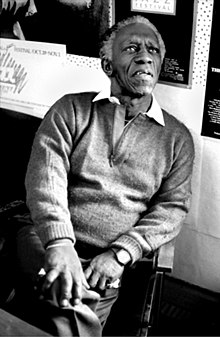
At radio interview, KJAZ, Alameda, California, October 11, 1982
Blakey went on to tape dozens of albums with a constantly changing grouping of Jazz Messengers. He had a policy of encouraging immature musicians: every bit he remarked on-mic during the alive session which resulted in the A Night at Birdland albums in 1954: "I'm gonna stay with the youngsters. When these go too quondam I'll get some younger ones. Keeps the listen active."[xiv] After weathering the fusion era in the 1970s, the popularity of the Jazz Messengers faded away. Merely Blakey'south band continued performing with new jazz men such as Terence Blanchard and Kenny Garrett.[32]
He connected performing and touring with the group through the end of the 1980s. Ralph Peterson, Jr. joined in 1983 as a 2nd drummer due to Blakey's failing health. Ron Wynn notes that Blakey had "played with such force and fury that he somewhen lost much of his hearing, and at the stop of his life, often played strictly by instinct."[33] He stubbornly refused to article of clothing a hearing aid, arguing that it threw his timing off, then most of the time he played by sensing vibrations. Javon Jackson, who played in Blakey's final lineup, claimed that he exaggerated the extent of his hearing loss. "In my opinion, his deafness was a little exaggerated, and it was exaggerated by him. He didn't hear well out of one ear, but he could hear but fine out the other one. He could hear you just fine when you played something desperately and he was quick to say 'Hey, you lot missed that there.' But anything like 'I don't think I'll be bachelor for the next gig', he'd say 'Huh? I can't hear y'all.'" Another bandmate, Geoffrey Keezer, claimed that 'He was selectively deaf. He'd go deaf when yous asked him about money, only if it was existent quiet and you talked to him one-on-one, then he could hear y'all just fine.'"[34]
Blakey's final performances were in July 1990.[8] [35] He died on October 16 of lung cancer.[two] [6] [12]
Drumming style [edit]
Blakey assumed an aggressive swing style of contemporaries Chick Webb, Sid Catlett and Ray Bauduc early in his career,[ten] and is known, alongside Kenny Clarke and Max Roach, as ane of the inventors of the modern bebop style of drumming. Max Roach described him thus:
Art was an original… He'due south the simply drummer whose time I recognize immediately. And his signature style was amazing; we used to call him 'Thunder.' When I first met him on 52d Street in 1944, he already had the polyrhythmic thing down. Art was perhaps the all-time at maintaining independence with all four limbs. He was doing it before everyone was."[11]
His drumming form made standing use of the traditional grip, though in later appearances he is besides seen using a matched grip.[36] In a 1973 drum boxing with Ginger Baker he tin be seen repeatedly changing grip during his performance.[37]
Equally the supporting materials for Ken Burns's serial Jazz notes, "Blakey is a major figure in modern jazz and an important stylist in drums. From his earliest recording sessions with Eckstine, and particularly in his celebrated sessions with Monk in 1947, he exudes ability and originality, creating a dark cymbal sound punctuated by frequent loud snare and bass pulsate accents in triplets or cross-rhythms." This source continues:
Although Blakey discourages comparison of his own music with African drumming, he adopted several African devices after his visit in 1948–9, including rapping on the side of the drum and using his elbow on the tom-tom to modify the pitch. Later he organized recording sessions with multiple drummers, including some African musicians and pieces. His much-imitated trademark, the forceful closing of the howdy-hat on every second and fourth beat out, has been part of his mode since 1950–51. … A loud and domineering drummer, Blakey also listens and responds to his soloists.[21] [38]
Blakey used a multifariousness of drum kits throughout his career including Premier and Sonor. He likewise used Zildjian cymbals for much of his career, starting out as one of their top endorsers in the '50s and '60s and being one of their start artists to use the initial prototypes of what would become their Thousand line of cymbals. He also endorsed Paiste cymbals for much of the '70s and '80s, beingness ane of the showtime users of Paiste's 2002 line upon their introduction in the early '70s. He would ultimately revert to Zildjian for the afterwards role of his career largely using their A line, specially favoring their newer sweet model of cymbals.
Legacy [edit]
The legacy of Blakey and his bands is not simply the music they produced, but also the opportunities they provided for several generations of jazz musicians.[39]
The Jazz Messengers nurtured and influenced many of the fundamental figures of the hard bop move of the tardily 1950s to early 1960s, and of the Neotraditionalist move of the 1980s and 1990s, both of which had the Jazz Messengers in a stylistically seminal role. In the words of drummer Cindy Blackman shortly after Blakey's death, "When jazz was in danger of dying out [during the 1970s], at that place was all the same a scene. Fine art kept it going."[39] Blakey was inducted into the Jazz Hall of Fame (in 1982), the Grammy Hall of Fame (in 2001), and was awarded the Grammy Lifetime Achievement Laurels in 2005.[1]
Personal life [edit]
In addition to his musical interests, Blakey was described by Jerry "Tiger" Pearson equally a storyteller, as having a "large appetite for music [...] women [and] food", and an interest in boxing.[40]
Blakey married four times, and had long-lasting and other relationships throughout his life. He married his first wife, Clarice Stewart, while nonetheless a teen, then Diana Bates (1956), Atsuko Nakamura (1968), and Anne Arnold (1983[40]).[1] He had 10 children from these relationships — daughters Gwendolyn, Evelyn, Jackie, Kadijah, Sakeena and Akira, and sons Fine art Jr., Takashi, Kenji and Gamal.[1] Sandy Warren, another longtime companion of Blakey, published a book of reminiscences and favorite nutrient recipes from the period of the late 1970s to early on 1980s when Blakey lived in Northfield, New Jersey, with Warren and their son, Takashi.[41] [42] [43]
Blakey traveled for a yr in Due west Africa (1948) to explore the culture and faith of Islam he would adopt alongside changing his name; his conversion took place in the late 1940s at a time when other African-Americans were being influenced by the Ahmadi missionary Kahili Ahmed Nasir, according to the Encyclopedia of Muslim-American History, and at in one case in that menses, Blakey led a turbaned, Qur'an-reading jazz band called the 17 Messengers (perhaps all Muslim, reflecting notions of the Prophet's and music'southward roles as conduits of the divine message).[1] A friend recollects that when "Art took upwards the organized religion [...] he did so on his own terms", proverb that "Muslim imams would come over to his place, and they would pray and talk, then a few hours after [nosotros] would become [...] to a restaurant [...and] have a drink and guild some ribs", and suggests that reasons for the proper name change included the pragmatic: that "like many other black jazz musicians who adopted Muslim names", musicians did so to allow themselves to "check into hotels and enter 'white simply places' under the assumption they were not African-American".[40]
Drummer Keith Hollis, reflecting on Blakey's early life, states that his young man drummer "wound up doing drugs to cope";[41] like many of the era, Blakey and his bands were known for their drug use (namely heroin) while traveling and performing (with varying accounts of Blakey's influence on others in this regard).[xl] [44]
Other specific recollections have Blakey forswearing serious potable while playing (later on beingness disciplined by drummer Sid Catlett early in his career for drinking while performing), and suggest that the influence of "clean-living true cat" Wynton Marsalis led to a period where he was less affected by drugs during performances.[xl] Blakey was a heavy smoker; he appears in a cloud of smoke on the Buhaina's Delight album embrace,[45] and in extended footage of a 1973 appearance with Ginger Bakery, Blakey begins a long drummers' "duel" with cigarette alight.
Death [edit]
Blakey had been living in Manhattan when he died on October sixteen, 1990, of lung cancer, five days after his 71st birthday, at St. Vincent's Hospital and Medical Center. He was survived by 6 daughters (Gwendolyn, Evelyn, Jackie, Sakeena, Kadijah and Akira), and three sons (Takashi, Gamal, and Kenji).[11]
At his funeral at the Abyssinian Baptist Church on October 22, 1990, a tribute group assembled of past Jazz Messengers including Brian Lynch, Javon Jackson, Geoffrey Keezer, Wynton Marsalis, Terence Blanchard, Valery Ponomarev, Benny Golson, Donald Harrison, Essiet Okon Essiet, and drummer Kenny Washington performed several of the ring's most celebrated tunes, such every bit Golson'south "Along Came Betty", Bobby Timmons' "Moanin'", and Wayne Shorter'south "1 by 1". Jackson, a member of Blakey's last Jazz Messengers grouping, recalled how his experiences with the drummer inverse his life, saying that "He taught me how to be a man. How to stand up up and be accounted for". Musicians Jackie McLean, Ray Bryant, Dizzy Gillespie, and Max Roach also paid tribute to Blakey at his funeral.[46]
Awards [edit]
- Down Beat Jazz Hall of Fame Reader's Choice Award (1981)[3]
- Jazz Hall of Fame Induction (1982)[47]
- Grammy Award All-time Jazz Instrumental Functioning, Group, for the album New York Scene (1984)[48]
- Grammy Hall of Fame Induction for the single "Moanin'" (1998)[48]
- Grammy Hall of Fame Induction for the album Moanin' (2001)[48]
- Grammy Lifetime Achievement Award (2005; awarded posthumously)[49]
Discography [edit]
- Blakey'south solo or semi-solo albums are denoted in bold.
- Album appointment based on recording year, not release twelvemonth.
- New Sounds (1952)
- A Nighttime at Birdland Vol. 1 (1954)
- A Dark at Birdland Vol. 2 (1954)
- A Nighttime at Birdland Vol. 3 (1954)
- Blakey (1954)
- At the Cafe Bohemia, Vol. 1 (1955)
- At the Cafe Bohemia, Vol. ii (1955)
- The Jazz Messengers (1956)
- Originally (1956)
- Difficult Bop (1956)
- Ritual (1957)
- Drum Suite (1957)
- Orgy in Rhythm (1957)
- A Midnight Session (1957)
- Selections from Lerner and Loewe's... (1957)
- Cu-Bop (1957)
- With Thelonious Monk (1957)
- Hard Drive (1957)
- Large Band (1957)
- Moanin' (1958)
- Drums Around the Corner (1958)
- Holiday for Skins (1958)
- 1958 – Paris Olympia (1958)
- Des Femmes Disparaissent (1958)
- The St. Germain Club (1958)
- At the Jazz Corner of the World (1959)
- Les Liaisons Dangereuses (1959)
- Africaine (1959)
- The Théâtre des Champs-Élysées (1959)
- Paris Jam Session (1959)
- The Big Shell (1960)
- A Night in Tunisia (1961)
- Art Blakey!!!!! Jazz Messengers!!!!! (1961)
References [edit]
- ^ a b c d e f Brandi Denison, 2010, "Blakey, Art (Ibn Buhaina Abdullah)", Encyclopedia of Muslim-American History (Edward Eastward. Curtis, ed.), pp. 85f (New York: Infobase Publishing); ISBN 1438130406; available here [i]
- ^ a b c d due east f g h Feather, Leonard; Gitler, Ira (1999). The Biographical Encyclopedia of Jazz . Oxford University Press, U.s.. p. 65. ISBN9780199729074.
- ^ a b "Downbeat Hall of Fame". downbeat.com . Retrieved September 17, 2014.
- ^ "Modern Drummer's Readers Poll Archive, 1979–2014". Modern Drummer . Retrieved August 10, 2015.
- ^ "They similar the old songs". Oakland Tribune. July 8, 1956. p. 125. Retrieved September 28, 2018.
- ^ a b c d "Fine art Blakey biography". biography.com . Retrieved September 16, 2014.
- ^ a b c d e f g h i Gourse, Leslie (2002). Art Blakey profile. Music Sales Group. ISBN9780857128379.
- ^ a b c d e f Goldsher, Alan (2008). Hard bop academy: the sidemen of Art Blakey and the Jazz Messengers (1st ed.). Milwaukee, WI: Hal Leonard. pp. ii–v. ISBN9780634037931.
- ^ a b c d "Art Blakey". National Endowment for the Arts . Retrieved September sixteen, 2014.
- ^ a b c d e "Art Blakey contour". pbs.org . Retrieved September xvi, 2014.
- ^ a b c Watrous, Peter (October 17, 1990). "Art Blakey, Jazz Great, Is Dead; A Drummer and Band Leader, 71". The New York Times.
- ^ a b "Blakey, Art; Buhaina, Abdullah Ibn". Library PSU. Archived from the original on September 10, 2013. Retrieved September 16, 2014.
- ^ a b c Miller, Yawu (1994). "Art Blakey". In Ramsay, John (ed.). Fine art Blakey'due south jazz messages. Miami, FL: Manhattan Music Publications. ISBN0760400091.
- ^ a b c d e Kelsey, Chris. "Fine art Blakey". allmusic.com . Retrieved September sixteen, 2014.
- ^ "Art Blakey profile". allaboutjazz.com . Retrieved September sixteen, 2014.
- ^ "Blakey, Fine art". jazz.com . Retrieved September 16, 2014.
- ^ Burt Korall (July 29, 2004). Drummin' Men: The Heartbeat of Jazz The Bebop Years. Oxford University Press. pp. 131–. ISBN978-0-nineteen-517664-three.
- ^ Jason Bivins (2015). Spirits Rejoice!: Jazz and American Religion. Oxford University Press. pp. 39–. ISBN978-0-19-023091-3.
- ^ Taylor, Arthur. Note and Tones: Musician-to-musician Interviews. Da Capo Printing. ISBN9780786751112.
- ^ "Art Blakey profile". britannica.com . Retrieved September sixteen, 2014.
- ^ a b The New Grove Dictionary of Music and Musicians, 2nd Edition (2001)
- ^ Art Blakey (1957). Ritual:The Jazz Messengers featuring Art Blakey (LP record). Pacific Jazz.
- ^ Cole, Juan (Dec 27, 2018). "How Muslim-Americans Helped Create Modernistic Jazz". Informed Comment . Retrieved May ix, 2020.
- ^ a b c d "Art Blakey discography". jazzdisco.org . Retrieved September 17, 2014.
- ^ "Monk's Music". Monkzone.com. June 26, 1957. Archived from the original on December i, 2008. Retrieved October 6, 2011.
- ^ a b Feather, Leonard (1955). At the Buffet Bohemia, Vol. ane (liner notes). BLP 1508. The Jazz Messengers. Blue Note Records.
- ^ Gitler, Ira (1955). Horace Silverish and the Jazz Messengers (liner notes). BLP 1518. Horace Silverish and the Jazz Messengers. Blueish Note Records.
- ^ Avakian, George (1956). The Jazz Messengers (liner notes). CL 897. The Jazz Messengers. Columbia Records.
- ^ Hentoff, Nat (1958). A Dark in Tunisia (liner notes). LAX 1115. Art Blakey'due south Jazz Messengers. Vik Records.
- ^ Feather, Leonard (1958). Art Blakey and the Jazz Messengers (liner notes). BLP 4003. Art Blakey and the Jazz Messengers. Blueish Annotation Records.
- ^ "Fine art Blakey". drummerworld.com . Retrieved September 17, 2014.
- ^ Skelly, Richard. "Kenny Garrett: Biography". Allmusic. Retrieved March 21, 2010.
- ^ Wynn, Ron (1994), Ron Wynn (ed.), All Music Guide to Jazz, M. Erlewine, V. Bogdanov, San Francisco, CA: Miller Freeman, p. ninety, ISBN0-87930-308-v
- ^ Hard Bop Academy: The Sidemen of Art Blakey and the Jazz Messengers, Alan Goldsher, pp 81
- ^ Schwartz, Steve; Fitzgerald, Michael. "Chronology of Art Blakey (and the Jazz Messengers)". jazzdiscography.com . Retrieved September 16, 2014.
- ^ Come across, for instance: "Art Blakey solo", available at YouTube
- ^ Archived at Ghostarchive and the Wayback Machine: "Art Blakey & Ginger Baker Drum Duo". YouTube.
- ^ The New Grove Lexicon of Jazz, PBS.com; accessed April 2, 2015.
- ^ a b Watrous, Peter (Oct 17, 1990). "Fine art Blakey, Jazz Great, Is Dead; A Drummer and Ring Leader, 71". The New York Times . Retrieved April 25, 2010.
- ^ a b Regina Schaffer, 2014, "Art Blakey volition be remembered by Keith Hollis band, Jazz Vespers in Atlantic Metropolis Sunday", Atlantic Metropolis Insiders, January fourteen, 2014; available here [3]
- ^ Jeff Schwachter, 2010, "Art Blakey Topic of New Book by Atlantic Metropolis Author", Atlantic City Insiders, Nov 17, 2010; available here [4] Archived October sixteen, 2014, at the Wayback Automobile
- ^ Jeff Schwachter, 2005, "Remembering the Messenger: Jazz legend Art Blakey and his modest boondocks Atlantic Canton digs", Atlantic Metropolis Insiders, October 27, 2005; available here [5] Archived October 21, 2014, at the Wayback Car
- ^ John Moultrie, 2013, "Gary Bartz Talks About Drug Use Among Jazz Greats", 2013 Jazz Festival (iRock Jazz Team, irockjazz.com); available here [6]
- ^ LondonJazzCollector, 2011, "Fine art Blakey "Buhaina's Delight" (1961)";
- ^ Watrous, Peter (Oct 24, 1990). "Memorial Service for Fine art Blakey With Jokes, Memories and Jazz". The New York Times. ISSN 0362-4331. Retrieved November 11, 2019.
- ^ "Art Blakey Awards". Retrieved January 11, 2016.
- ^ a b c "Grammy Hall of Fame". Retrieved September 17, 2014.
- ^ "Grammy Lifetime Achievement Award". Grammy.com . Retrieved September 17, 2014.
External links [edit]
 | Wikimedia Commons has media related to Art Blakey. |
- Art Blakey at Find a Grave
Source: https://www.wikizero.com/en/Art_Blakey_%26_the_Jazz_Messengers
0 Response to "Youtube Art Blakey Featuring Lee Morgan and John Gilmore"
Enviar um comentário